
A welder posted a photo of his first laser welds to r/Welding. The thread hit 498 upvotes, and the top comment — 208 upvotes — said exactly what most people think the first time they see one:
“It looks nice but it also looks like a fake weld that you can peel right off.”
That’s the question behind this guide, and it’s one every buyer asks in some form: are laser welds strong — or do they just look clean?
The fear is real and specific. Laser welds are thin, narrow, and almost too pretty. They don’t have the fat, stacked, fish-scale bead of a TIG weld. To a welder trained on traditional processes, a laser weld can read as “cold lap” or “not fused” — a bead sitting on top of the metal instead of fused into it.
We make laser welders. So when we tell you the answer isn’t what your eyes tell you, take it as evidence, not optimism. Here’s the honest truth about laser weld strength — the physics, the test data, and how to judge a weld by proof instead of appearance.
The 208-Upvote "Fake Weld" Comment
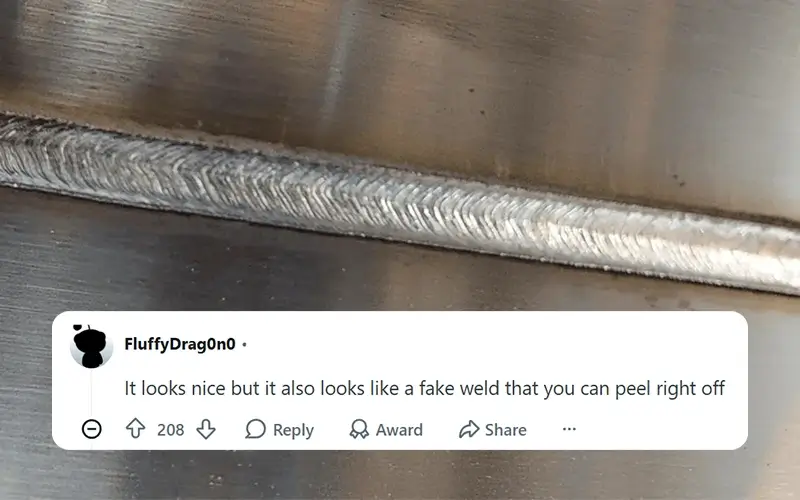
Read that Reddit thread and you’ll find experienced welders — people who weld for a living — genuinely convinced the laser weld was weak. A MIG welder wrote it “looks like it’s ALL cold lap,” as if the bead was “just sitting on top.” Another said you could “stick a feeler gauge between the bottom toe and parent metal.”
These aren’t amateurs. They’re exactly the people whose judgment you’d trust in a shop. And they were wrong — not because they were bad at their jobs, but because they were applying the wrong measuring stick.
One commenter explained it plainly: “They penetrate very deep but not very wide. You can’t use the same visual standards you use to judge MIG.”
That’s the core of the misunderstanding. A laser weld and a TIG weld can be equally strong while looking completely different — because they fail differently, fuse differently, and are shaped by different physics.
You're Judging a Laser Weld by the Wrong Standards
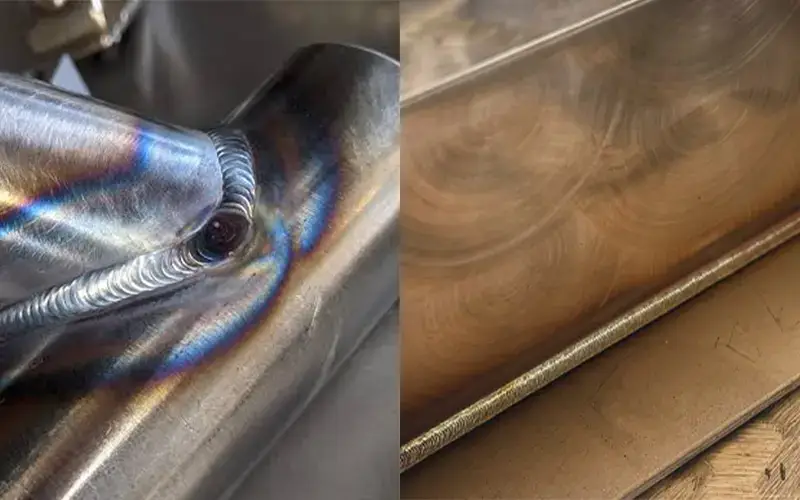
For a century, welders have read quality from the outside in. A good TIG or MIG weld shows a wide, rippled bead with toes that “wash in” smoothly — the visible signature of heat spreading into the parent metal.
A laser weld doesn’t do that. It concentrates its energy into a tiny spot, so it melts deep instead of wide. The result is a narrow, smooth, almost recessed-looking seam. To a TIG welder, that reads as under-penetrated. In reality, it’s often the opposite.
Think of an iceberg: the surface you see is a fraction of what sits below. A TIG weld is a broad, shallow bond. A laser weld is a deep, narrow one. Same job done, different silhouette.
The operator who knows this puts it best: the toes only look unfused because the heat input is so precise. “They’re just fine — you just gotta learn how a laser weld is supposed to look.”
Keyhole Welding: Why Deep Looks Skinny
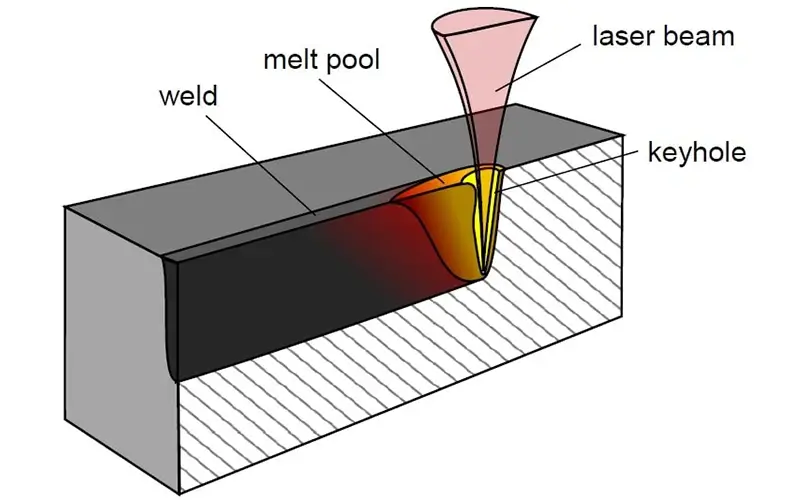
The reason laser welds are narrow isn’t that the laser is weak. It’s that the laser welds by a fundamentally different mechanism: the keyhole.
At the weld point, the laser’s concentrated energy is intense enough to vaporize metal, boring a small cavity — a keyhole — into the workpiece. The beam then reflects around the inside of that cavity, delivering energy deep into the metal instead of just across its surface. Filler wire feeds in behind the beam as it travels.
The result is a weld with an extreme depth-to-width ratio — up to 1:20 in skilled hands — far deeper than a traditional weld of the same visible width.
That depth is why the surface looks so modest. The energy went down, not sideways. A narrow bead isn’t a shallow bead; it’s a bead that put its heat where it counts.
That concentrated heat has a second benefit. Less energy spread into the surrounding part means less distortion, less warping, and a cleaner heat-affected zone on thin material — exactly the thing that makes TIG such a struggle on 0.5–2mm stainless.
The Proof: A 1,000,000-Cycle Test and AWS 7.4
You shouldn’t take physics on faith. Neither did the engineers. Here’s what actual qualification looks like.
A weld process engineer and certified weld inspector (CWI) described testing an IPG fiber laser — the same class of unit that Miller Electric adopted for its own lineup. On 1018 low-carbon steel with 0.045″ filler wire, running 1700 watts with 5mm oscillation, the machine produced 0.250 inches of penetration with a 0.200-inch-wide deposit.
Then they tested it. The welds survived over 1,000,000 cycles in a 3,000 psi hydraulic high-cycle accelerated life test, qualifying at a 3-to-1 safety factor for production use.
That’s not a marketing number. That’s a fatigue test — the kind of qualification that structural and pressure applications require before a process is ever approved for production.
It’s also codified. The American Welding Society publishes AWS 7.4, the standard for laser welding qualification, with laser-specific guidance from organizations like the Laser Institute of America. Laser welding has a defined path through metallographic examination, fillet break tests, and accelerated fatigue life testing. A shop that wants to use laser welding on certified work has a written route to do it.
The common fear — “no inspector will certify a laser weld” — isn’t the technology’s fault. It’s a matter of running the same qualification tests a TIG weld would have to pass, and the process is documented and doable.
How to Judge a Laser Weld Yourself
If you’re buying a laser welder — or buying parts welded on one — don’t judge the process by a photo. Judge it the way an engineer would.
What a good laser weld looks like. A narrow, uniform bead with consistent width. No craters at the start or stop. No spatter, no porosity, no cracks. Smooth, even toes once you learn to read the shape.
What appearance can’t tell you. Whether the weld is actually fused through the full joint. For that, you need verification, not eyesight.
How to verify. Three things, in order of rigor:
- Process parameters. A documented welding procedure specification (WPS) showing power, travel speed, wire feed, and gas — the recipe that was actually used.
- Macro etch / cross-section. Cut a sample, polish and etch it, and you can see penetration depth and fusion directly. This is the single most convincing piece of evidence a supplier can show you.
- Destructive testing. A fillet break test or bend test proves the weld holds under load, not just under inspection.
Even a company like TRUMPF — the pioneer of industrial laser welding — proves the point with exactly this kind of test. In the video below, a laser weld goes through a destructive strength test, and the result speaks for itself.
Red flags. Porosity, cracking, inconsistent width, heavy spatter — or a seller who can’t produce test data, a cross-section photo, or a WPS. A supplier who talks about how pretty the weld looks but won’t show you what’s underneath is telling you something.
One thing worth knowing before you compare machines: laser welders range from a couple thousand dollars to thirty thousand and up, and the gap isn’t just markup — it’s specifications, certification, and support. A machine’s real strength is only as trustworthy as the test data and documentation behind it. That’s why these verification steps matter more than the sticker price.
Where Laser Weld Quality Wins — and Where It Doesn't
Honesty cuts both ways. Laser welding isn’t universally “stronger.” It’s strong where it’s specified — and the wrong tool where it isn’t. If you’re still deciding whether a laser welder or a MIG welder fits your shop, that choice deserves its own look.
Where laser welds excel.
- Thin material, 0.5–2mm, where deep, low-distortion fusion matters most — the sweet spot of a handheld laser welder.
- Stainless and aluminum, where a clean, narrow weld beats a wide heat-damaged one.
- Autogenous work — sanitary stainless tubing, edge welds, and cosmetic seams that need no filler and no grinding.
- Repetitive production, where consistency across thousands of identical welds is the whole point.
- Dirty or coated surfaces. A laser burns through galvanizing or oxide before the filler lands, welding galvanized sheet smoothly where TIG would pop and spatter.
Those advantages aren’t theoretical. One shop running large galvanized drip pans called the laser welder “a godsend” — galvanized steel is notoriously miserable to weld with TIG, but the laser burns through the coating before the filler lands and lays a smooth, fully penetrated weld on 18-gauge sheet with stainless filler and zero prep. Another fabricator switched his aluminum work to a laser: 6063 square tube at 1/16-inch wall, parts he used to TIG-weld one by one. With a laser, he welds the same parts in about half the time, with smaller, cleaner welds — and a 14-foot aluminum sculpture seam that used to take an afternoon now goes down impressively fast.
Laser welding even replaces older automated processes. One engineer described swapping out a submerged arc welding (SAW) system that left flux inclusions unless the solidified flux was perfectly removed. The laser leaves no start or stop inclusions, and it eliminates a $25,000 flux reclamation system — along with the granular flux itself, a particulate carcinogen.
Where laser welds don’t win.
- Thick plate, where the depth advantage fades and traditional processes are more practical.
- Gap-heavy fit-up, where you need filler bridging a sloppy joint.
- Fillet-heavy structural work, where a MIG or stick weld remains the standard.
- Awkward angles the laser torch can’t reach.
The honest framing isn’t “laser is stronger.” It’s “laser is stronger in its lane, and that lane is thinner, cleaner, higher-volume work.”
Will a Laser Welder Take Your Welders' Jobs?
Every new automated process raises the same fear, and laser welding is no exception. One welder in that Reddit thread put it bluntly: “This is gonna put a bunch of us out of work.”
The more experienced answer came from welders who’ve seen automation before. There’s still a welder running the machine — there’s no such thing as a 100% automated process. Submerged arc welding, they pointed out, has been automated for decades, and it never put anyone out of work. Laser welding, as one put it, “is the same as MIG, just optimized for thin materials.”
The deeper truth shows up in the CNC analogy. When one shop automated its foam cutting with CNC, the cuts got more intricate, the machine needed constant maintenance, and the shop ended up paying its operator three times more — because the end product was so much better they couldn’t go back.
Laser welding changes the same way. It doesn’t eliminate the welder. It moves the welder’s value from hand-eye repetition to process judgment — parameters, fit-up, quality control. A laser is a tool that multiplies a skilled welder. It doesn’t replace one.
FAQ
Still not sure whether a laser weld is right for your parts? Here are the questions buyers ask most often:
In their proper applications, yes — a properly qualified laser weld passes the same fatigue and destructive tests as a traditional weld. The strength comes from deep penetration and a documented procedure, not from how the bead looks.
Laser welding uses a keyhole mechanism: the beam bores a cavity and reflects inside it, melting deep rather than wide. A narrow bead is a deep weld with minimal heat spread, not a weak one.
Yes. Engineered fiber lasers routinely achieve depth-to-width ratios far beyond traditional processes — up to 1:20 — and documented cases report 0.250″ of penetration on low-carbon steel at 1700W.
On thin stainless, laser welding is frequently the better process — lower distortion, no grinding, faster travel. Experienced TIG welders describe it as “as clean and penetrative as TIG, and as forgiving of cleanliness as MIG.”
They can be. AWS 7.4 covers laser welding qualification, and laser welds have passed metallographic, fillet break, and accelerated fatigue testing. Certification is a documented process, not a limitation of the technology.
Ask the supplier for a documented WPS, a macro-etch cross-section photo, and destructive test results — then request a weld sample on your own material and inspect it yourself.
Yes. Laser welding handles thin aluminum well, often in half the time of TIG. One fabricator reported laser-welding 6063 square tube at 1/16-inch wall with smaller, cleaner welds than his TIG work. Aluminum reflects the beam, so correct settings and proper eye protection matter.
The Bottom Line
A laser weld that “looks fake” to a TIG welder can carry a million-cycle fatigue rating. The disconnect is real, and it costs honest buyers sleep.
Judge a weld by evidence, not aesthetics — and judge a supplier by test data, not by how nice their photos look. A cross-section, a bend test, and a weld on your own material will tell you more in ten minutes than a hundred opinions ever will.
Are laser welds strong? In their lane — thin, clean, high-volume work — they’re not just strong. They’re often the strongest tool for the job.
Want proof on your own material? Tell us what you’re welding and we’ll run a free sample weld test and show you the cross-section — no obligation, just evidence.