
A few months ago, someone on r/Welding posted a short, worried note about handheld laser welder safety. His shop had just bought a 2000-watt handheld laser welder, and he was the only person who bothered to read the 50-page manual.
The problem wasn’t the machine. It was everyone else around it.
“One burned the floor here and there with it, and then just pulled the laser up to watch it, and absolutely carefree also pointed it at me a few times. The guy is 50 years old.”
He flagged the safety chapter. He wrote up step-by-step instructions — how to start the machine, how to weld, and how to do it safely. The first two got followed. The third got ignored, “because big boys got a new toy.”
The post earned 114 upvotes and hundreds of comments, because it named a fear that almost everyone in this industry quietly shares: what if this thing takes my eyes?
We make laser welders. So when we tell you the fear is justified — and then show you exactly how to take the danger out of it — you should trust that we’re not downplaying anything to make a sale.
Here’s the honest truth about handheld laser welder safety: the hazard is real, but it is completely controllable. The danger doesn’t live in the tool. It lives in ignorance, missing protection, and a shop with no rules. Fix those three things, and a laser welder becomes one of the safest, cleanest tools on your floor.
The Reddit Story That Got It Right
Read that Reddit thread and you’ll notice something telling. The poster wasn’t a nervous rookie. He was the only person in the room who actually read the instructions — and for that, his coworkers called him “paranoid.”
When he refused to run an angle grinder without its guard, he was overreacting. When he wore a respirator while welding, he was overreacting. When he said a 2000W laser shouldn’t be pointed at people, he was — somehow — the unreasonable one.
That’s not a safety problem. That’s a culture problem.
His story matters because it’s common. A shop buys a laser welder, treats it like a faster version of a MIG gun, and nobody bothers to learn what makes it different. The machine didn’t create the risk. The assumption — “it’s just a welder” — did.
And here’s the part most people get wrong: the danger isn’t hypothetical. It’s measurable, documented, and repeated by real operators with real scars.
Why the Fear Is Real
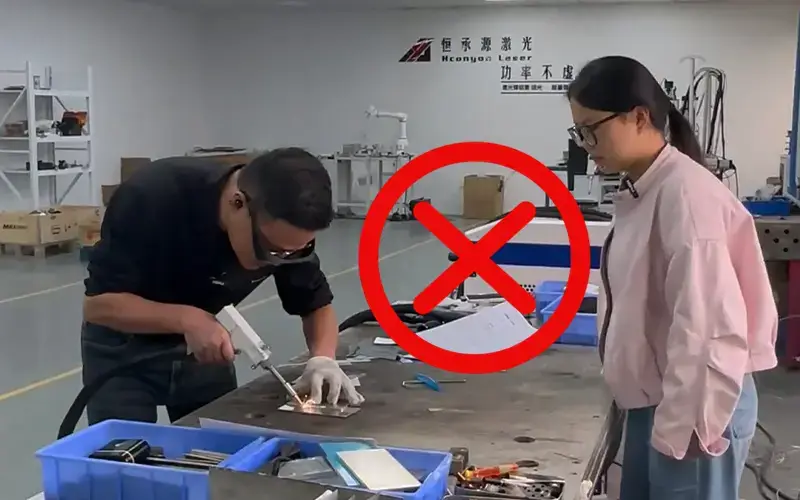
Let’s be blunt about what a handheld laser welder can do, because pretending otherwise doesn’t make anyone safer.
It’s invisible. A fiber laser welds at roughly 1080 nanometers — deep in the near-infrared, completely invisible to the human eye. You cannot see the beam, and critically, you cannot dodge what you cannot see.
Your blink reflex won’t save you. With visible light, your eye blinks shut in a fraction of a second when hit with something bright. Infrared light doesn’t trigger that reflex. By the time you realize something is wrong, the damage is already done.
The damage is permanent. Laser light at these wavelengths damages retinal cells that do not regenerate. There is no surgery that restores them. This is not a scare tactic; it is the biological reality of near-infrared exposure.
Reflections are as dangerous as the beam. One operator described hitting his finger with a laser welder indirectly — the beam bounced off aluminum. “The reflection can burn as much as direct fire,” he wrote. A stray bounce off a shiny surface carries the same energy as the primary beam.
It burns through protection you’d assume is enough. Another comment described a split-second exposure that burned straight through a leather welding glove and the cut-resistant glove underneath it. Two layers, gone in an instant. A third operator put 1,250 watts into the palm of his hand through a glove — over the following week, the skin around the burn died and peeled off in a circle an inch and a half wide.
These aren’t hypotheticals from a safety brochure. They’re first-person accounts from a single Reddit thread.
It’s a Class 4 laser. That’s the highest hazard class. One manufacturer’s manual classified a 1500W unit as “military grade.” In the United States, any laser above 5 milliwatts — five-thousandths of a watt — legally requires a designated Laser Safety Officer. A 2000-watt welder is roughly 400,000 times past that line.
So yes, the fear is real. Now here’s the part that should reassure you.
The Real Problem Isn't the Laser
Every accident in that thread — the burned floor, the finger, the palm — has one thing in common. None of them happened in a properly set up shop.
Look at the safe operators in the same discussion. The ones with the interlocked rooms and the proper eyewear didn’t have horror stories. They had a process. One professional Laser Safety Officer put it plainly:
“Lasers are fantastic tools to have, and they do not need to be feared when proper precautions are taken.”
Think about a table saw, a forklift, or high-voltage electricity. Each of those is lethal when mishandled. Industry still uses them every day, safely, because it applies the same three controls every time: engineering controls, personal protection, and training. A laser welder is no different.
The goal isn’t to be afraid of the laser. It’s to be disciplined around it.
The Three Layers of Laser Safety
Safety for a handheld laser welder stacks into three layers. None of them is optional. They work together.
Layer 1 — Engineering Controls
Engineering controls are the most important, because they protect everyone in the room whether or not they remember the rules.
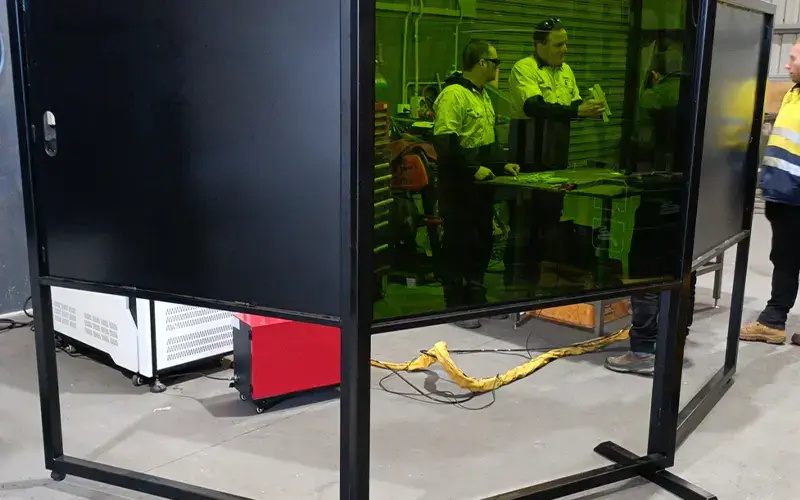
Contain the beam. The right setup puts the laser in its own enclosed cell or designated work area, walled off with laser-rated containment so a stray beam can’t escape into the rest of the shop. Operators who run these machines daily describe sealed rooms and movable fireproof barriers as standard, not optional.
Interlock the door. A properly set up cell has an interlock switch on the door: if the door isn’t fully closed, the laser won’t fire. This single feature removes the most common accident — someone walking in mid-weld.
Require contact to fire. Many handheld lasers are designed to only emit when the head is in contact with metal, completing the circuit. Lift it off the workpiece and the beam cuts out. It’s a simple safeguard that prevents the “wandered beam across the room” scenario.
Face the beam into a safe stop. In automated setups, the laser points into a water bath or dedicated beam dump, so the energy goes somewhere harmless if the workpiece moves.
If you take away one idea from this section, it’s this: a laser welder should never share open space with people who aren’t protected. Containment is the foundation.
Layer 2 — Personal Protective Equipment
PPE is your second layer, and it’s non-negotiable for anyone inside the controlled area.
Laser safety eyewear — the right kind. Not sunglasses. Not a standard welding shade. Laser safety glasses must be matched to the wavelength of your machine and rated for the power. For a fiber laser around 1080nm, look for eyewear covering the 1000–1100nm range with an Optical Density of OD 7 or higher (labelled LB7 in the EU). That rating protects up to 12,000 watts.
Buy your eyewear from a certified, tested manufacturer — ideally the original maker of your laser, whose lenses are matched to the machine’s exact wavelength — not an unverified online listing. Certified lenses typically run $200–300, and glass lenses hold up better to scratches and heat than plastic.
A laser welding hood. A proper laser welding hood filters the specific wavelength while letting enough visible light through to work. It works with your safety glasses, not instead of them.
Protective clothing — as the job demands. A full protective suit isn’t mandatory for every task, but cover skin that faces splash or overhead work. The two-glove story above is the reason: a stray bounce doesn’t care what you’re wearing unless it’s rated for it.
Fume control. For handheld welding on common materials, fume exposure is generally manageable — if you want extra peace of mind, a filtered mask does the job. CNC welding of specialty materials (coated metals, certain stainless and alloys) usually calls for a dedicated fume extraction and filtration system. Match the ventilation to what you’re actually welding.
Layer 3 — Administrative Controls and Training
Engineering and PPE protect you physically. Rules and training protect you systematically.
Designate a Laser Safety Officer (LSO). In the United States, OSHA rules require a certified LSO for lasers above 5mW — which is every welding laser. LSO training runs about a week and covers the administrative controls: who’s authorized to operate, where the beam is allowed, what PPE is required, and what to do in an incident. If your shop doesn’t have one, appoint one.
Know your legal obligations. Both the US (under OSHA and the ANSI Z136 standard) and the EU (where employers carry a legal duty to prevent hazardous optical radiation exposure) hold the employer responsible for worker safety. That’s not a technicality — it’s the reason serious shops treat laser safety as a compliance issue, not a suggestion.
Make the rules visible and enforced. Who operates the machine? Who supervises? When does work stop? If the answer to any of those is “nobody knows,” you have a culture problem, not a machine problem — exactly the situation in that Reddit thread.
Maintenance Is Part of Safety
Safety isn’t only about the moment of the weld. It’s also about keeping the machine in a state where it behaves predictably — because a degraded beam is an unpredictable beam.
The most overlooked maintenance item is the protective lens inside the gun. As it wears, the beam loses power. One operator measured it directly: a clean weld took roughly 800 watts on a fresh lens, and about 1100 watts on a worn one for the same penetration. That drift doesn’t just hurt consistency — a degraded beam can scatter more energy, which is the last thing you want around reflective surfaces.
The fiber optic cable, or “whip,” is another wear point. In a 24/7 shop running stainless, operators reported the cable as the most expensive repair item, because it flexes and twists constantly in use.
The takeaway is simple: a laser welder is a precision instrument, not a sledgehammer. Replace the protective lens on a schedule, keep the cable routed clean, and the machine stays predictable — and predictable is safe.
Buying the Right Machine Matters
Here’s where honesty cuts both ways. In that same Reddit thread, the LSO added a throwaway line about “the cheap Chinese fiber laser they purchased,” and the need for eyewear wide enough to “account for any variance in specs.”
It’s a fair worry, and it points to something real: not all laser welders are built to the same safety standard. When a machine’s power rating, wavelength, or certification is misstated — or when the seller disappears the moment something breaks — the buyer inherits every safety risk that a proper machine would have engineered out.
What separates a safe machine from a gamble isn’t marketing. It’s a few checkable things:
- Transparent specs. The real power, wavelength, and certifications are stated and verifiable, not inflated on the listing.
- Built-in safety design. Multiple interlocks, contact-to-fire requirement, and an ergonomic torch that reduces accidental pointing.
- A factory you can verify. A genuine manufacturer lets you visit or audit the line — not a trading company that won’t reveal where the machine is actually made.
- Real certification. CE compliance for the European market, and documentation you can hand to an inspector or your insurer.
A laser welder with these things is a safe, fast, clean production tool. One without them is a liability wearing a welder’s mask.
Not sure whether the machine you’re considering checks these boxes? The fastest way to find out is to have a supplier demonstrate the safety features in front of you, on your own material. More on that at the end.
Safety FAQ
It carries real hazards — primarily permanent eye damage from invisible near-infrared light, plus fire risk from reflections. These are completely controllable with the right containment, eyewear, and training. The danger comes from operating without those controls, not from the technology itself.
Match them to your machine’s wavelength and power. For a fiber laser around 1080nm, choose eyewear covering 1000–1100nm with an Optical Density of OD 7 or higher (LB7 in the EU). Buy certified lenses from a tested manufacturer — ideally your laser’s original maker — not unverified online listings.
Yes. A reflection off a shiny surface like aluminum carries the same energy as the direct beam. This is why containment and full-coverage eyewear matter: a bounce you never saw coming is still a hazard.
In the United States, yes — OSHA requires a certified LSO for lasers above 5mW, which includes every welding laser. In the EU, employers carry the legal duty to prevent hazardous optical exposure. Even outside those regions, appointing someone to own laser safety is the single most effective step you can take.
Look for multiple interlocks (door and machine-level), a contact-to-fire requirement so the beam only emits against the workpiece, an ergonomic torch, and verified certifications like CE. These features are the difference between a contained tool and an open hazard.
For handheld welding on common materials, fume exposure is generally manageable; a filtered mask adds peace of mind. CNC welding of specialty materials usually requires a dedicated fume extraction and filtration system. Match ventilation to the material.
The Bottom Line
A handheld laser welder will not take your eyes. Carelessness with one will.
The fear you feel when you first unbox one is healthy — it’s the same respect you’d give a table saw or a forklift. The mistake is letting that fear turn into either denial (“it’s just a welder”) or paralysis. The answer is the middle path: contain the beam, protect the operator, and train the team.
Do those three things, and a laser welder stops being a thing to fear and becomes the fastest, cleanest tool on your floor — the one that welds thin stainless without distortion and finishes a weld with no grinding — benefits you can verify on your own material in minutes.
Want to see a properly built, safety-certified laser welder in action on your own material? Tell us what you're welding and we'll walk you through the safety features and run a free sample weld test — no obligation, just proof.