
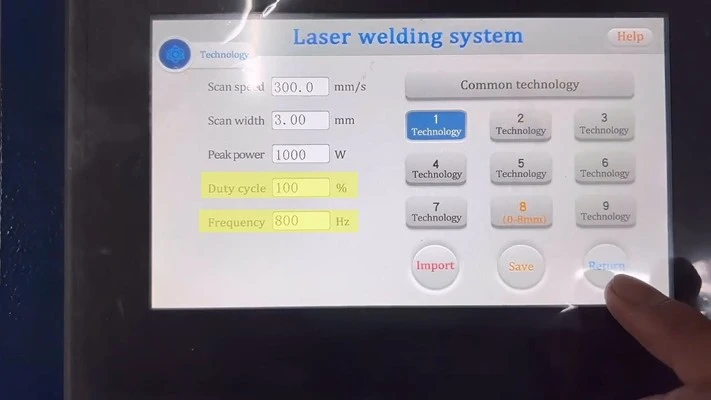
In the world of precision laser welding, “power” isn’t the only knob you can turn. If you want to achieve high-quality welds without warping or burning through your workpiece, you must master two critical parameters: Duty Cycle and Pulse Frequency.
Whether you are working with thick carbon steel or ultra-thin stainless steel, understanding these settings is what separates a novice from a professional.
What is Duty Cycle in Laser Welding?
Duty Cycle is a percentage value that represents the ratio of time the laser is actually “on” within a total given period.
100% Duty Cycle: The laser is firing continuously (Continuous Wave).
90% Duty Cycle: In a 1-second window, the laser fires for 0.9 seconds and rests for 0.1 seconds.
Think of it as “slicing” the laser energy. By adjusting the duty cycle, you can control the average power delivered to the material without changing the peak power. This is essential for managing the heat-affected zone (HAZ) and preventing material deformation.
Understanding Pulse Frequency (Hz)
While duty cycle tells us how long the laser stays on, Pulse Frequency tells us how often it switches on and off in one second. It is measured in Hertz (Hz).
High Frequency (e.g., 2000Hz): The laser delivers 2,000 “energy packets” per second. This creates a more continuous-looking weld bead and allows for faster welding speeds.
Low Frequency: The energy packets are spaced further apart, allowing more time for heat to dissipate between pulses.
In a handheld laser welder, these two parameters work in tandem. If your duty cycle is set to 90%, the frequency determines how those 90% “on-time” segments are distributed throughout that one second.
The Secret Weapon for Thin Sheet Metal Welding (0.4mm - 0.6mm)
One of the biggest challenges in handheld laser welding is working with ultra-thin materials like 0.4mm or 0.5mm sheets.
Using a continuous laser (100% duty cycle) often results in burn-through, while simply lowering the power might lead to an unstable melt pool or discontinuous wire feeding. This is where the synergy of duty cycle and frequency becomes a “cheat code”:
Reduce the Duty Cycle: Lowering it to 60% or 70% effectively reduces the average heat input while maintaining the peak power needed to melt the metal.
Optimize Frequency: Combine this with a strategic frequency to ensure the energy is discrete yet dense enough to form a stable, controlled melt pool.
This strategy allows you to achieve deep penetration where needed without the risk of destroying thin workpieces.
Conclusion: Why These Settings Matter
Duty cycle and pulse frequency may seem like advanced settings, but they are the keys to versatility. By mastering the balance between energy delivery and heat dissipation, you can expand your applications from heavy industrial parts to delicate, precision thin-plate welding.
You may also like

How to use laser clean mode
How to Use the Laser Cleaning Mode on 3-in-1 Laser Welder The cleaning mode on a 3-in-1 laser welder removes