
- 90%+ of black smoke issues in handheld laser welding come from three easily-troubleshooting problems: parameter mismatch, consumable wear, material contamination
- Follow the troubleshooting order “check consumables first → adjust parameters → check external → inspect internal”, most problems can be located and solved within 30 minutes
- Kaihuan Laser KH series handheld welders feature built-in smoke warning system, reducing the occurrence of such failures by over 75%
Introduction
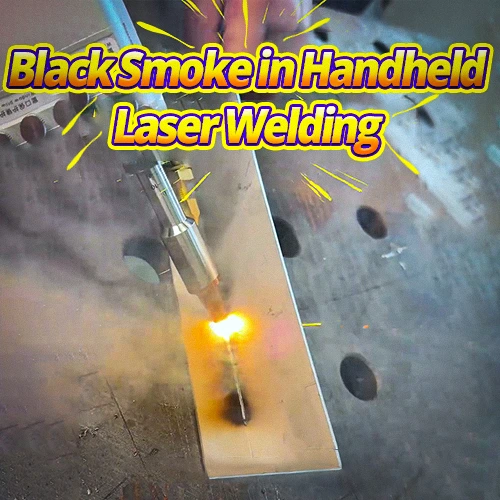
Black smoke appearing during handheld laser welding is a common failure in industrial production. It not only affects welding quality, leading to insufficient weld strength and poor appearance, but also accelerates the wear of core optical components such as protective lenses and focusing mirrors if left unresolved, increasing equipment maintenance costs.
According to Kaihuan Laser’s 2025 industrial laser equipment failure statistics, this issue accounts for 32% of all handheld welder after-sales inquiries, and 85% of failures can be quickly resolved by users themselves without waiting for an engineer visit.
This article systematically sorts out the four core causes of black smoke in handheld welding, provides actionable troubleshooting steps and long-term prevention solutions, helping you quickly resume production and reduce downtime losses.
1. Core Causes of Black Smoke and Corresponding Solutions
1.1 Incorrect Parameter Settings (35% of cases)
Symptoms: Black smoke appears immediately after parameter adjustment, with obvious oxidation on the weld surface Root Causes:
- Laser power is too high, exceeding the melting threshold of the welding material, causing excessive vaporization
- Welding speed is too slow, laser stays in the same position for too long, leading to material ablation
- Insufficient shielding gas flow or incorrect gas path direction, failing to effectively isolate oxygen, metal oxidizes at high temperature to produce black smoke Solution Steps:
- Refer to the welding parameter table, reduce laser power by 10-15% according to material thickness and type
- Increase welding speed to 20-30mm/s (adjust based on material thickness), avoid staying at a single point for more than 0.5 seconds
- Check shielding gas pressure, adjust to 0.3-0.5MPa, confirm the gas outlet is aligned 1-2cm above the welding pool
1.2 Optical Consumable Contamination or Wear (30% of cases)
Symptoms: Welding worked fine before, black smoke gradually appears, accompanied by decreased welding penetration Root Causes:
- Protective lens surface is contaminated with welding slag and dust, reducing laser transmittance and causing unstable actual output energy
- Focusing lens and collimating lens are worn, beam quality deteriorates, energy concentration decreases
- Internal optical path of the gun head is contaminated, leading to laser energy attenuation Solution Steps:
- After power off, take out the protective lens, wipe the surface stains clockwise with an alcohol cotton pad, replace it directly if there are scratches
- Check focusing lens and collimating lens, it is recommended to replace directly if used for more than 3 months
- Purge the internal optical path of the gun head with dry nitrogen to remove residual dust
Protective lens is an easily-consumed part. It is recommended to check every 8 hours of welding, replace it in time when seriously contaminated to avoid damaging more expensive focusing and collimating lenses.
1.3 Welding Material Contamination (25% of cases)
Symptoms: Black smoke only appears when welding specific materials, returns to normal after changing other materials Root Causes:
- The surface of the welding material has impurities such as oil, paint, oxide layer, zinc coating, which burn at high temperature to produce black smoke
- The welding wire surface has anti-rust oil and impurities, which vaporize during welding Solution Steps:
- Before welding, polish the welding area with a stainless steel wire wheel or sandpaper to remove surface oxide layer, oil and zinc coating
- Wipe off anti-rust oil on the welding wire before use, store in a dry environment to avoid moisture
- When welding galvanized materials, appropriately reduce power and increase shielding gas flow to reduce zinc vapor oxidation
1.4 Internal Equipment Failure (10% of cases)
Symptoms: Black smoke still exists after checking the above three problems, accompanied by unstable laser output Root Causes:
- The internal optical path of the laser is contaminated, output energy attenuates
- Cooling system failure, laser cavity temperature rises too high, output wavelength shifts
- Feed fiber cable is worn, energy transmission efficiency decreases Solution Steps:
- Contact your equipment supplier engineer to test laser output power and beam quality
- Check cooling system water temperature and water pressure, confirm it operates within the normal range of 22-25℃
- Test fiber insertion loss, replace the fiber cable if loss exceeds 3dB
2. Quick Troubleshooting Flowchart
- Check whether the welding material surface has oil or oxide layer → clean and retest
- Take out the protective lens to check for contamination or scratches → clean or replace and retest
- Check welding power, speed and shielding gas parameters → adjust to the recommended range and retest
- Check whether laser output power is normal → contact after-sales engineer for processing
3. Long-Term Prevention Plan
- Establish daily equipment inspection system: check protective lens, shielding gas pressure and parameter configuration before each shift of welding
- Pre-treat welding materials in advance, remove surface impurities, store welding wires in a dry and sealed environment
- Conduct comprehensive equipment maintenance every 3 months, clean the internal optical path and check optical consumable wear
- Optional Kaihuan Laser welding fume purification system, which collects welding fume in real time and reduces dust contamination on optical components
Conclusion
Most black smoke problems in handheld laser welding are conventional faults that can be quickly checked. Following the troubleshooting order “check consumables first → adjust parameters → check external → inspect internal”, most problems can be solved within 30 minutes. Doing daily equipment inspection and material pre-treatment in daily production can reduce the incidence of such failures by more than 80%.
If you still cannot solve the problem after troubleshooting, you can contact Kaihuan Laser technical support team at any time, we provide 24-hour industrial equipment failure response service.
FAQ
There is still black smoke after replacing the protective lens, what should I do?
It is recommended to check whether the focusing lens is contaminated and whether the shielding gas path is blocked. These two are the core reasons why the problem still exists after replacing the protective lens.
Why is there particularly heavy black smoke when welding stainless steel?
If the stainless steel surface has drawing oil or polishing paste residue, it will produce a lot of black smoke during welding. Wipe the welding area with alcohol before welding to solve this problem.
What impact does long-term black smoke have on the equipment?
Smoke and dust will adhere to the surface of optical lenses, accelerate lens wear, and in severe cases can enter the inside of the laser, causing optical path contamination and increasing maintenance costs.
You might also like
Knowledge

Laser Welder Focus Adjustment
The bead suddenly turns black and grey. Penetration drops. The sparks go from a steady, fine stream to something noisy
09/26/2026
No Comments